Determining Agentic and Traditional Workflow Automation
With Agentforce, enterprises can now unlock new paradigms for automated work that can’t easily be reduced to rules. These new capabilities include resolving customer intent from unstructured conversations, coordinating multi-party processes across systems, and responding to operational conditions in real time. Agentic workflows use automation designed to reason toward outcomes rather than execute predefined steps. Meeting this demand requires a platform that operates across the full spectrum of automation complexity, and a framework showing where each capability fits.
Agentforce combines the Einstein Trust Layer, Reasoning Engine, Agent Script, Flow, Apex, and Data 360 into a single, unified platform. This combination handles everything from simple record trigger automation to complex multi-agent orchestration across voice, vision, documents, and real-time telemetry. MuleSoft extends this platform with the MuleSoft fabric, governance, and cross-system orchestration needed to connect agentic workflows across an enterprise. Agentforce Operations (previously Agentforce Supply Chain) applies these capabilities to the specific demands of operational and manufacturing processes.
This guide introduces the Orchestration Density framework and guidelines for making informed decisions across this product landscape. The framework provides architects with a repeatable approach to select the right tools and patterns using density levels for intelligent automation use cases on the Salesforce Platform.
| Product | Description |
|---|---|
| Agentforce | Agentforce is Salesforce’s platform for building and deploying AI agents. It uses the Atlas engine to trigger real-time, dynamically grounded actions through Apex, and Data 360. |
| Agent Script | Agent Script is a declarative domain-specific language (DSL) used in Agentforce Builder to define workflows, business rules, and conversational logic for agents |
| Agentforce Grid | Agentforce Grid is an AI-native, no-code spreadsheet-like interface for rapidly designing and operationalizing AI workflows at scale. |
| Agentforce Operations | Agentforce Operations (previously Agentforce Supply Chain) is an AI-powered collaborative workflow management orchestration platform designed to streamline and automate back office business processes. |
| MuleSoft | MuleSoft is a comprehensive, unified, and open platform for enterprise integration and agentic governance. Through API-led connectivity and MuleSoft Agent Fabric and Agent Broker, it serves as the integration fabric, governance layer, and cross-system orchestration foundation for connecting agentic workflows across the enterprise |
| Flows and Apex | Salesforce Flow is a powerful, point-and-click automation tool for building complex business processes visually without code. Salesforce Apex is a proprietary, object-oriented programming language for the Salesforce platform, similar to Java. It’sused to build custom business logic, automate processes, and extend core CRM functionalities beyond declarative tools. |
Agentforce represents a fundamental shift in how work gets done on the Salesforce Platform, from rules-based automation to reasoning-based workflows. To unlock its potential, architects must make deliberate, informed decisions about where agents fit, how they are composed, and what they orchestrate. The following principles provide a repeatable guideline for agentic decisions.
-
Use the right tool for the right task. Use orchestration density based on execution path, modality mix, and goal complexity to determine the best fit solution.
-
Use Traditional Automation with Flows and Apex for rule-based deterministic work, where the outcome can be entirely scoped and defined by a set of rules. Traditional automation results in a static execution path, which guarantees predictable and repeatable outcomes and is crucial for auditability. Choose traditional automation for tasks that demand strict compliance and legal adherence.
-
Use Agentforce Grid for bulk inference use cases with low to medium orchestration complexity. This pattern uses single-turn generative reasoning to classify, score, or summarize data across a high volume of CRM records, ensuring high-throughput execution with immediate auditability.
-
Use Agentforce with Agent Script for tasks that have open-ended goals where the desired outcome is known, but the exact execution path can’t be specified at design time. Apply this pattern to requirements that require reasoning via guided determinism, to ensure predictable and traceable outcomes.
-
Use Agentforce Operations to streamline and automate collaborative business processes with AI-enabled management for supply chain workflows.
-
-
Avoid applying agentic workflows to low-orchestration-density use cases. Evaluate tradeoffs between traditional and agentic automation for functional and non-functional requirements. Traditional automation can offer the scale, reliability, and performance required for your use case.
-
Adopt an Agent Automation Hybrid approach, which combines Agentforce and traditional automation with Flows and Apex, when this synergy offers greater value than using either agentic or traditional automation in isolation.
The Salesforce sObject is traditionally the primary entry point for record automation. The system executes logic based on rules, beginning immediately after a Data Manipulation Language (DML) event such as insert, update, or delete. To decide between tools for efficient record-triggered automation, we introduced Automation Density as a means to measure the complexity of the system, considering automation quantity, record volume, and dependency sprawl. Traditional automation is limited by the extensive pre-work required to bring data into a structured, schema-compliant, and rules-based construct.
Agentic automation upgrades traditional automation using user intent or unstructured data as the input where reasoning can be applied to reach a desired outcome. Architects must decide when to leverage probabilistic reasoning for multi-modal unstructured data and when to enforce guided, deterministic workflows to mitigate the risk of unpredictable outcomes.
When the requirement shifts from executing rules-based steps to reasoning toward outcomes, architects need a standardized framework to evaluate the reasoning depth and goal complexity of the proposed solution.
Orchestration density is the measure of complexity within an agentic workflow. Three factors determine orchestration density: execution path, goal complexity and modality mix. While automation density measures the physical complexity of the system’s rules and volume, orchestration density measures the reasoning complexity of the agent’s path toward a goal. Use the composite orchestration density to evaluate your design requirements and map to the architectural standard.
- Execution Path: The degree to which workflow can be fully scoped and specified at design time. A fully specified workflow means the workflow defines every branch and outcome resulting in a predetermined execution path. A non-specifiable workflow has a path that can emerge during runtime through reasoning against contextual data and instructions.
- Goal Complexity: The number of distinct outcomes, decision points, and path variations that the workflow must resolve at runtime. A low-complexity workflow handles a single contained task with a predetermined outcome, while a high-complexity goal spans multiple stages with competing or conflicting goals with edge cases that can’t be anticipated at design time.
- Modality Mix: The range of input types a workflow must process, and the output forms it must produce. A low modality mix reads standard CRM fields and produces record updates. A medium modality consumes a mix of structured CRM fields and static, unstructured data, like email bodies or case transcripts, to produce record updates. A high modality mix consumes dynamic, real-time streams, like live audio or telemetry, and produces multi-modal outputs across multiple external systems.
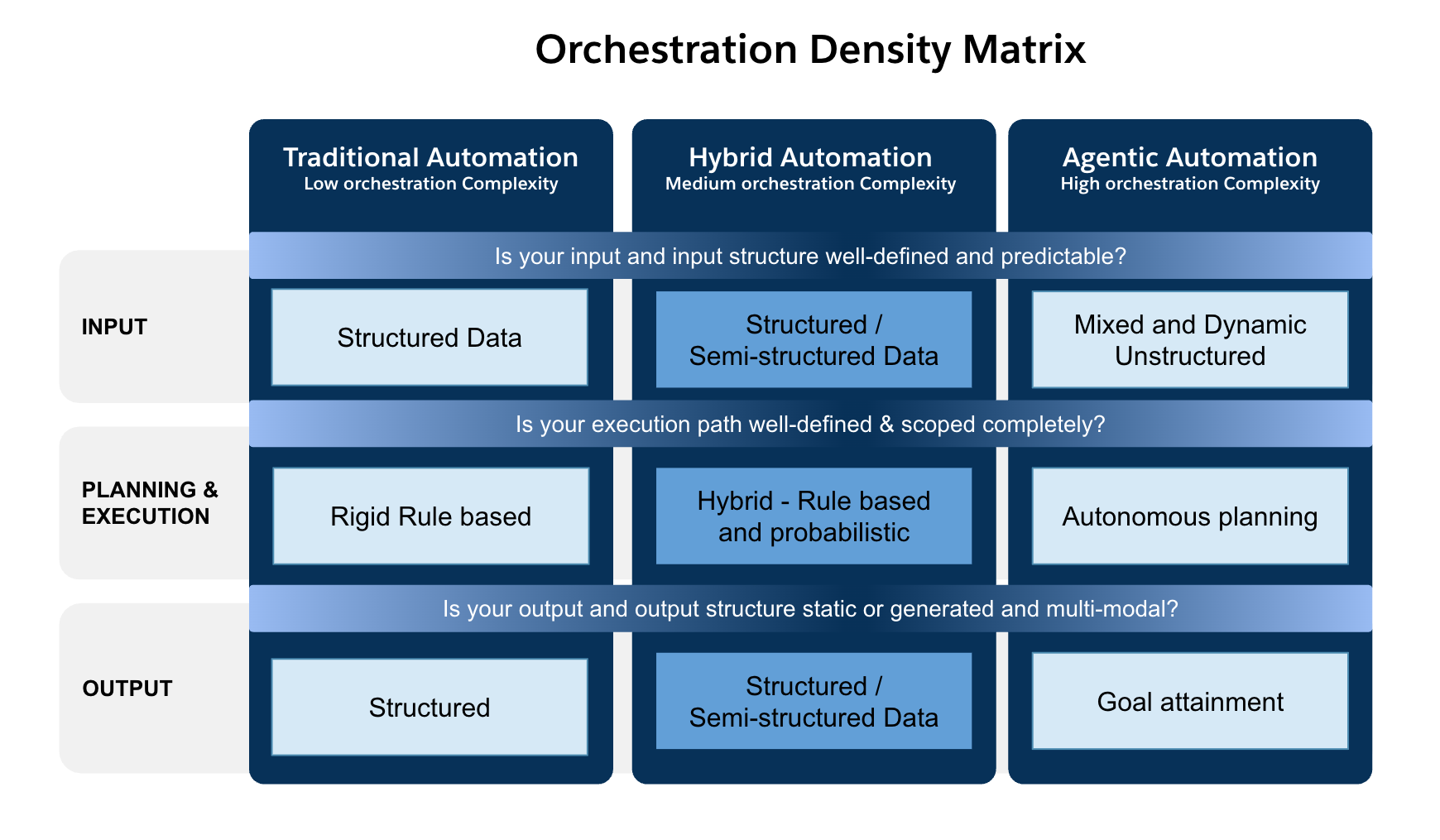
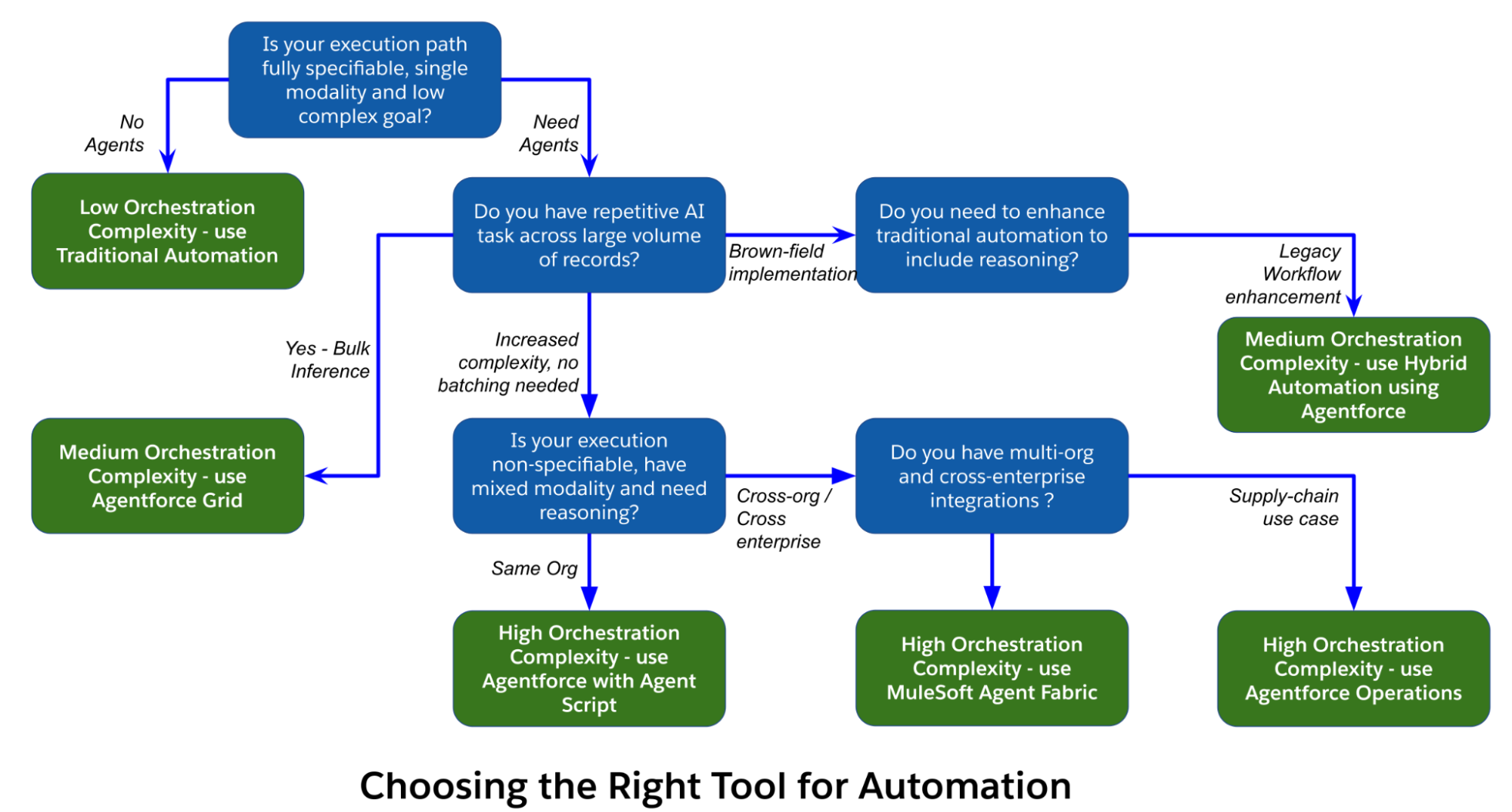
Determining the appropriate orchestration density level requires sequentially evaluating the execution path, goal complexity, and modality mix. Inspect the execution path first. If a path is fully specifiable, begin with traditional automation. Using an Agentic solution just to orchestrate and execute a deterministic path without any reasoning requirement is an anti-pattern. It leads to agent sprawl (excessive, unmanaged AI agent proliferation) and agent slop (low-quality, unnecessary AI-generated output), resulting in poor value returns.
For partial or non-specifiable paths, continue evaluating goal complexity. If the goal complexity is well-defined but certain nodes along the path need probabilistic evaluations, consider calling agents from Flow or Apex to meet the specific localized need. Instead, if the steps in the execution path need one or more AI-driven requirements across a large set of records, consider Agentforce Grid. Grid supports multi-step, sheet-based workflows through multiple AI or agent columns. It is best suited for bulk, row-oriented execution. This approach ensures that the workflow remains highly performant and auditable, invoking probabilistic reasoning only where the path cannot be predefined.
As goal complexity increases with competing dimensions (for example, determining an insurance claim payout along with fraud detection, compliance with policies, and customer satisfaction) and non-specifiable execution paths, consider Agentforce with Agent Script for guided determinism in your automation. For cross-enterprise use cases that involve Salesforce and third-party systems, use MuleSoft Fabric and Agent Broker.
Finally, evaluate the modality mix to identify the necessary technical capabilities, such as multi-modal connection or specialized integration. Modality mix functions as a capability selector, not a density calculator. It helps determine the infrastructure required to handle the input and output shape of the solution, without altering its fundamental orchestration logic.
Use this matrix to determine the architectural standard for your agentic automation. Balance traditional and agentic automation by selecting the approach that solves your automation problem.
- Traditional Automation (Low orchestration density): Use traditional automation when the process is triggered by a record change, the data is structured, logic is rule-based and pre-determined, and the outcome must be predictable (for example, standard price calculations or auto-task creation).
- Agentforce Grid (Low to medium orchestration density): Use Agentforce Grid when bulk AI tasks across existing records must be processed (for example, summarize the last 50 cases for every Account in this list, calculate the sentiment score and persist the score in the case field).
- Hybrid Orchestration (High-Order Augmented Automation): Use hybrid orchestration when automating a complex end-to-end business process (for example, claims processing or onboarding) that requires the planning capabilities of AI but the transaction integrity of Flow and Apex.
- Agentforce Agent Script (High Intent Complexity): Use Agent Script when the entry point is unstructured (for example, chat, email, and voice) and the resolution requires a conversation or the ability to handle ambiguous user requests.
| Density Level | Execution Path | Goal Complexity | Modality Mix | Architectural Standard |
|---|---|---|---|---|
| Low | Fully specifiable | Low: Single contained task with pre-defined outcomes. | Single Modality: Reads and writes structured Salesforce Object records. | Record-Triggered Automation. If the use case has at least one reasoning task, use Agentic Actions in the workflow. |
| Low - Medium | Fully or partially specifiable | Low: Series of steps with pre-defined outcomes. | Mixed Modalities: Input or output can have a mix of structured and unstructured data. | Use Agentforce Grid Batch Inferences for bulk tasks across existing records with agentic action. |
| Medium | Fully or partially specifiable. The execution path is pre-defined but intermediate steps need reasoning. | Medium: Series of Apex or Flow based steps with variable outcomes. | Mixed Modalities: Input or output can have a mix of low volume structured and unstructured data. | Hybrid (Agentforce + Apex/Flow): Use Agentforce for high density reasoning and planning, Agent Script for guided determinism, and Apex/Flow for orchestration. |
| High | Partially or non-specifiable. The goal is pre-defined but intermediate steps need runtime context and user intent. | High: Multiple competing goals with heavy reasoning needs require deterministic outcomes. | Mixed Modalities: Input or output can have a mix of high volume structured and unstructured data arriving in real time. | Use Agent Script to balance deterministic control with reasoning. Use MuleSoft Agent Fabric for third party MCPs or A2A for complex multi-agent collaboration. |
| Capability | Traditional Automation (Flow/Apex) | Agentforce Grid | Agentforce | Agentforce with Agent Script |
|---|---|---|---|---|
| Logic Type & Determinism | Deterministic: Uses fixed if-then-else logic. The execution path is 100% predictable based on record state. | Mixed: Deterministic via structured steps while individual AI steps can be probabilistic. | Probabilistic: Uses multi-turn reasoning to determine the best path toward a goal. | Guided Determinism: Uses reasoning to plan the path and allows execution on deterministic node paths. |
| Speed of Delivery | Recommended (Flow): Visual tools allow rapid building of record-triggered logic without code. | Recommended for repetitive AI automation: Fastest way to apply AI logic across existing record sets without building new flows. | Recommended: For configuration of Subagents (previously Topics), Instructions, and Skill mapping for a specific domain or problem. | Recommended: For advanced mapping of state-based graphs and edge logic. |
| Input Modality | Recommended for Structured Only: Limited to CRM fields and related record collections. | Recommended for Semi-Structured: Processes bulk text (descriptions, transcripts) from record fields. | Recommended for Multi-modal: Processes natural language, voice, and vision (unstructured data). | Recommended for High Density: Synthesizes multi-modal inputs with real-time system state data. |
| Reasoning Depth (Planning) | Not Available: Logic is imperative; it cannot “think” or plan steps dynamically. However, data can be sent to agents. | Low: Single-step inference applied across a record set (batch AI). | Medium/High: Uses reasoning loops (Reason-Act-Observe) to resolve complex intent. | Governed: Reasoning is restricted to navigating a pre-defined graph of business states. |
| Modularity & Reusability | Recommended: Modular by default via subflows and Apex classes. | Limited: Logic is typically tied to the specific grid row. Column setups and templated workflows can be reused across the entire row set. | Available: Skills (Flows/Apex) are reused across different Subagents (previously Topics) and connected agents. | Recommended: Nodes in the Agent Graph are discrete, reusable functional units. |
| Transaction & DML Control | Recommended (Apex): Full control over Savepoints, rollbacks, and bulkification. | Available: Each row is processed independently, so execution scope is per record. | Limited: Actions are executed as individual, decoupled steps in a session. | Recommended: Uses Flow/Apex nodes to serve as deterministic anchors for all DML. Distributed transaction control support across agents is limited. |
| Ambiguity Handling | Not Available: Requires pre-defined paths. Unexpected input leads to failure or static errors. | Limited: Output quality depends on prompt grounding. The workflow cannot interactively ask for clarification. | Recommended: Handles “unknown” states by asking questions or selecting alternate skills. | Available: Uses “Fallback Nodes” to manage reasoning failures or process timeouts. |
| Visibility & Governance | Recommended: Flow Trigger Explorer provides a visual map of all record-triggered logic. | Available: Grid-based UI provides clear visibility into row-level results and supports auditability of outputs. | Available: Monitoring Logs provide transparency into how the agent made decisions. | Requires Expertise: Requires monitoring both the Graph traversal and LLM inference logs. |
| Performance & Scale | Recommended Optimized for high-volume synchronous record processing. | Recommended Efficiently processes bulk AI tasks across large data volumes. | Latency-Sensitive Dependent on inference time; unsuitable for high-density bulk updates. | Moderate Suitable for complex long-horizon tasks, but has higher overhead. |
This table provides general best-fit recommendations for various use cases.
| Use Case | Description | Best-Fit | Rationale |
|---|---|---|---|
| Record processing | Automation triggered by a DML event on a structured Salesforce object where every branch and outcome can be fully defined at design time. | Use Record-Triggered flow. This is a low density traditional automation. | Low orchestration density. Single modality (structured CRM fields) and a single contained goal with a predictable, auditable execution path. |
| Transactional control with complex logic | Automation requiring savepoints, rollbacks, partial commits, or bulk-safe data manipulation across high record volumes. | Use Apex for traditional, low-density deterministic automation. | Low orchestration density. Apex provides full control over transaction integrity, deduplication of expensive computation, and platform-level caching - capabilities not available in Flow. |
| Moderately complex logic within a structured process | Automation where the overall process is rule-based but individual steps require computation or data manipulation beyond declarative capability. | Use Flow with Invocable Apex for low-density deterministic logic. | Low orchestration density. Flow acts as the orchestration layer; Invocable Apex encapsulates high-complexity operations as reusable, bulk-safe components. |
| Scheduled and temporal processing | Automation that must execute at a dynamically calculated future date relative to a record event. | Use Traditional automation (record-triggered flows) for low-density deterministic processing. | Low orchestration density. Flow scheduled paths provide automatic scheduling, cancellation, and rescheduling if record data changes - not natively available in Apex triggers. |
| Bulk record inference | Applying a single AI reasoning step uniformly across a large set of existing records to generate a classification, summary, or score. | Use Agentforce Grid for batch inference and to use repetitive agentic capabilities at scale. | Medium orchestration density. Batch Inference with single modality at scale: the agent reads structured record fields and writes a uniform output back to each record. Low goal complexity with one repetitive inference pattern. |
| Unstructured input resolution | Automation where the entry point is a natural language request, email, or conversation that must be interpreted, classified, and resolved through reasoning. | Use Agentforce for medium-density, intent-driven, unstructured input resolution. | Medium orchestration density. Mixed modality: the agent consumes unstructured conversational input, then produces text responses or structured record updates. The goal requires resolving user intent across a bounded set of outcomes. |
| Moderately complex logic within a probabilistic process | Automation where the overall process is rule-based, but individual steps require AI capabilities like summary or RAG retrieval. | Use Flow with Invocable Apex and Prompt Templates for low-density deterministic processes requiring AI capabilities. | Medium orchestration density. Flow acts as the orchestration layer while Prompt Templates, Agentforce Service agent, and Agentforce Employee agent are exposed as Invocable actions. |
| Guided process orchestration | Automation spanning across multi-step workflows where one action’s completion triggers additional actions | Use Agent Script with Actions for high-density, non-specified execution paths that require guided process orchestration. | High orchestration density - mixed modality across input and output. Competing outcomes and edge cases that cannot be fully anticipated at design time. Agent Script provides guided determinism. |
| Cross-system process orchestration | Automation coordinating a multi-step business process across multiple backend systems where no single system owns the end-to-end flow | Use MuleSoft Process API with Agent Broker for medium to high-density cross-system process orchestration. | High orchestration density - Process APIs encapsulate complex multi-step business logic so agents do not need to understand the orchestration behind operations like order processing or inventory checks. Agent Broker dynamically sequences and invokes required agents and tools from a single natural language goal. |
| Backend system abstraction | Orchestration where agents must interface with legacy systems, databases, or third-party SaaS platforms lacking native Agentforce connectivity. | Use MuleSoft with the MCP Connector to wrap legacy systems and provide model context. | Medium orchestration density. System APIs offer a secure, abstracted interface to systems of record, ensuring agentic workflows are decoupled from backend complexity. The MCP Connector transforms MuleSoft applications into MCP-compliant servers for immediate discoverability and invocation. |
| High-volume document processing and exception handling | Automation that reads, interprets, and reconciles inbound structured and semi-structured documents against existing records at scale - handling variances, partial matches, and exceptions with appropriate manual intervention. | Use Agentforce Operations for medium-density, intent-driven high-volume document processing. | Medium orchestration density with semi-structured input modality. Goal complexity driven by matching rules, exception paths, and approval thresholds per document. Requires reasoning per record, not uniform single-turn inference. |
| Multi-agent orchestration across vendors | Automation requires collaboration between specialised agents built on different platforms or vendors. | Use MuleSoft with A2A Connector and Agent Fabric for multi-agent orchestration across different systems. | Medium to high orchestration density. The A2A Connector enables peer-to-peer multi-agent workflows with enterprise-grade governance and reliability, regardless of where each agent is built or hosted. |
| Unstructured document to workflow conversion | Automation where operational processes defined in unstructured sources (SOPs, supplier rule documents, or process diagrams) must be converted into executable agentic workflows without manual coding. | Use Agentforce Operations for high-density, emergent unstructured documents to workflow conversion. | High density with a high modality mix on input. Ingests PDFs, Word documents, and image-based diagrams. Goal complexity determined by the scope and branching of the ingested process. Execution path cannot be specified at design time. |
| Multi-party orchestration | Automation spanning the coordinated onboarding of external parties - collecting required data, verifying compliance, managing approvals, and updating systems of record across many concurrent onboarding tracks. | Use Agentforce Operations for medium-to-high density, intent-driven to emergent multi-party orchestration. | Multiple interdependent verification and approval steps must resolve sequentially before onboarding completes. Modality mix includes structured records, unstructured documents, and external party communications. |
| Predictive asset intervention | Automation where a predictive engine ingests real-time telemetry to identify impending failure conditions and triggers a coordinated multi-step back-office response. | Use Agentforce Operations and Agentforce for Manufacturing for high-density predictive asset intervention. | Data Cloud handles high-modality IoT telemetry and anomaly detection. Agentforce Operations then orchestrates the medium-modality back-office workflow—managing field service records, inventory data, and customer communications—resolving the process end-to-end. |
| Large-scale supplier communication management | Automation managing ongoing structured and semi-structured communications across a large supplier base - including order acknowledgements, delivery date changes, and exception notifications. | Use Agentforce Operations for Batch Inferences to a medium density supplier communication management. | Where communications are uniform across suppliers, use Agentforce Grid for batch processing. Where responses require contextual reasoning per supplier relationship, escalate to medium density with Agentforce Operations. |
| Lead Management (High-Speed, Intelligent Routing) | Automation that ingests real-time marketing responses, uses AI scoring and Data Cloud enrichment for qualification, and uses flows for sub-minute, intelligent assignment and routing of high-quality leads to the appropriate sales team. | Use Traditional Automation (Flow) + Data Cloud and AI for medium-density high-speed intelligent lead routing. | Requires high speed (Speed to Lead < 1 min) and complex, data-driven routing based on AI lead scoring, job level, and activity history. Uses Flows for fast, deterministic assignment logic, augmented by probabilistic AI and Data Cloud for lead qualification and enrichment. |
| Lead Nurturing | Nurtures low-score leads until they are ready for a sales conversation. | Use Lead Nurturing Agent for targeting and improving low-quality leads for medium to high density automation. | Sends personalized, multi-touch emails grounded with lead data and customer success stories. It handles email responses and uses Flow for handoff. |
| Inbound Lead Qualification | Qualifies and nurtures higher-score inbound leads autonomously. | Use Lead Nurturing Agent to qualify and engage leads. | Executes multi-touch email outbound, meeting booking, product Q&A, and objection handling. It can operate in a “send as seller” mode, sending emails through the assigned lead owner. |
Latency
Synchronous record-triggered flows execute within the platform transaction and complete in milliseconds. Agentforce inference time is dependent on the Atlas Reasoning Engine and scales with reasoning depth and modality complexity. Agentforce is unsuitable for high-volume, synchronous record processing where latency is a primary constraint.
Cost
The reasoning cost of an agentic workflow must be justified against the business value of the outcome. For high-volume, low-orchestration density tasks where a deterministic path exists, traditional automation or Agentforce Grid might be more economical than an end-to-end agentic workflow. Ensure the design accommodates the right retry pattern with explicit max-retry limits and breakers. This guardrail limits the compounding cost-overrun risk associated with bulk processing.
Governor Limits
Evaluate high-volume agentic workflows against daily platform limits for asynchronous execution. Agentforce Grid batch operations follow standard platform transaction limits. For automation involving Salesforce Objects, consider the total daily number of DML operations, as Salesforce enforces both shared resource management in a multitenant environment, and governor limits to prevent runaway automations from monopolizing shared resources.
Auditability and Compliance
Traditional automation produces fully auditable execution trails through Flow Trigger Explorer and Apex logs. Agentforce-based end-to-end or hybrid patterns produce reasoning logs that provide transparency into agent decision making, but they require expertise to interpret. Guided determinism via Agent Script is the recommended pattern for regulated industries where full execution auditability is a compliance requirement.
Escalation
Agentic workflows operating at high density should incorporate explicit human approval or escalation gates for actions with irreversible consequences, such as financial transactions, regulatory submissions, or supplier commitments. Agent Script conditional controls provide the mechanism for enforcing these gates deterministically within an otherwise agentic workflow.
Prioritize simplicity in your orchestration design. Start at the minimal orchestration level that can achieve the goal, validate it under real load, and iterate. Every additional agent, handoff or dependency in your chain introduces a new surface that can produce inconsistent behavior.
In your specifiable execution path, at nodes where reasoning is required, begin embedding an agent. Follow the best practices for building Agents in Agentforce. Avoid packing numerous subagents (previously “topics”) and never bloat instructions. Agents deployed in automation use cases can afford to be lean, as they are not the only interface. Choose the right primitive for chaining. An orchestration (delegation) pattern has tighter control over the execution sequence and can delegate sub-tasks to specialists. Avoid choreographed (handoff) patterns. If you must implement a handoff design, provide the receiving agent with the goal, context and state so that it can optimize globally rather than local objectives.
Avoid actions or tools sprawl. Actions are where agent reasoning is realized, and their design determines whether they produce reliable outcomes or failures. Every action must return a structured, observable response that the AI agent can use to plan the next turn of the conversation.
Having more than one action (and different output constructs) to do the same task degrades the agent’s ability to reason or pick the right tool for the job. It may cause the agent to miss nuances. Overlapping action definitions risks wrong classification. Make sure your action library is audited, versioned and conforms to Subagent (previously Topic) scope.
Define observable goals. Define the goal as an observable outcome, not just a procedure. A vague goal invites agent drift. Augment with a specifiable execution path. Use Agent Graph with hybrid reasoning to model the goal as a graph node with explicit state. The runtime tracks the agent’s current position in the workflow and restores it after tangential inputs; it won’t lose the goal when it receives additional information in the context window.
Test and evaluate. Implement a robust testing and evaluation framework to validate the reasoning of probabilistic nodes and the output of agentic automations. Verify execution paths against an expected result path to ensure that the model arrives at the correct outcome. Prevent silent failures where an agent falsely reports success, or enters into an infinite or non-recoverable loop by asserting the results at execution steps. Use session tracing to inspect turn-by-turn interactions, reasoning engine executions, actions, prompt and gateway inputs/outputs, error messages, and final responses.
| Agentforce | Traditional Automation | Integration |
|---|---|---|
About the Author
Arvind Palaniswamy is a Software Engineering Architect at the Office of the Chief Architect, Well-Architected Team. He likes to frame complex systems in their simplest forms using first principles. He understands engineering, operations, and business through decades of experience and MS/MBA(Kellogg) education.