Leveraging MuleSoft and Informatica: “Better Together”
This document provides a framework for real-time application connectivity and data management using MuleSoft and Informatica.
MuleSoft and Informatica provide foundational pillars for a modern, high-performance integration strategy. While both reside in the same ecosystem, they solve distinct architectural challenges. Leading enterprises deploy these platforms in tandem to create a comprehensive “Better Together” framework that meets the full spectrum of data and application needs.
The most agile organizations succeed by decoupling data management from application connectivity. MuleSoft and Informatica act as specialized partners. MuleSoft delivers secure, performant, interactive application experiences through a service-based architecture, while Informatica ensures data integrity, quality, and governance at massive scale. Architects leverage both to apply the right engine to the right integration pattern, optimizing for both performance and long-term scalability.
Leverage MuleSoft and Informatica as specialized partners. MuleSoft and Informatica are two foundational pillars of a modern integration strategy. Sophisticated enterprises require both to meet complex architectural needs. These platforms deliver maximum value when used side-by-side. This combined approach decouples application connectivity from data management, ensuring that architects choose the right platform and pattern for long-term scalability.
MuleSoft leads on Application Connectivity patterns:
-
Real-time API Mediation and Governance: MuleSoft provides the foundation for an API-led connectivity approach. It manages and secures synchronous and asynchronous interactions though experience, process, and system APIs.
-
Event Handling and Orchestration: MuleSoft consumes and publishes events across Salesforce and external queues. It orchestrates complex, multi-step business processes where control flow, latency, and transactional correctness are critical.
-
Transactional Reliability: MuleSoft ensures data integrity within short-lived transactions (for example, creating a customer record across CRM and ERP systems) where failures require immediate rollback or specific error handling.
-
AI Agent and workflow automation: MuleSoft Agent Fabric supports multiple pillars for the agentic enterprise–discovery, orchestration, governance, and observability–with products included in its MuleSoft Anypoint platform.
Informatica leads on Data Management patterns.
-
Large-scale Data Movement and Transformation: Informatica optimizes Extract, Transform, Load (ETL) or Extract, Load, Transform (ELT) processes for massive datasets—the traditional domain of data warehousing and data lake ingestion.
-
Data Quality, Lineage, and Governance: Informatica provides enterprise-grade capabilities for data quality and profiling. It tracks data lineage from source to consumption and enforces long-lived data governance policies across the enterprise.
-
Master Data Management (MDM): Informatica creates and maintains the “single source of truth” of key data entities (Customer, Product, Supplier, and others) by consolidating data from disparate systems.
Integration Strategy: When selecting either MuleSoft or Informatica, an enterprise must first assess the integration strategy required for the use case. They must assess if the project prioritizes data consistency or service exposure. The answer determines which platform provides the foundation of the integration capability framework.
Platform Selection: Architects must evaluate the primary requirement of the use case. Interactive processes composed from independent services require MuleSoft. Conversely, bulk data movement, transformation, and management require Informatica. Complex architectures may require both.
To succeed in the new agentic era, enterprises must address two critical requirements:
- Dynamic Connectivity: This is where MuleSoft excels. It provides the real-time orchestration layer. It manages the stateful connection of applications, APIs, and agents to support business processes. MuleSoft enables the entire ecosystem to immediately respond to a business moment.
- Trusted Context (Reliable Data): This is Informatica’s strength. Informatica provides the data management layer. It executes high-scale ingestion and replication of data, while also providing the crucial trust layer–governing, mastering and ensuring the high-quality and reliability of data.
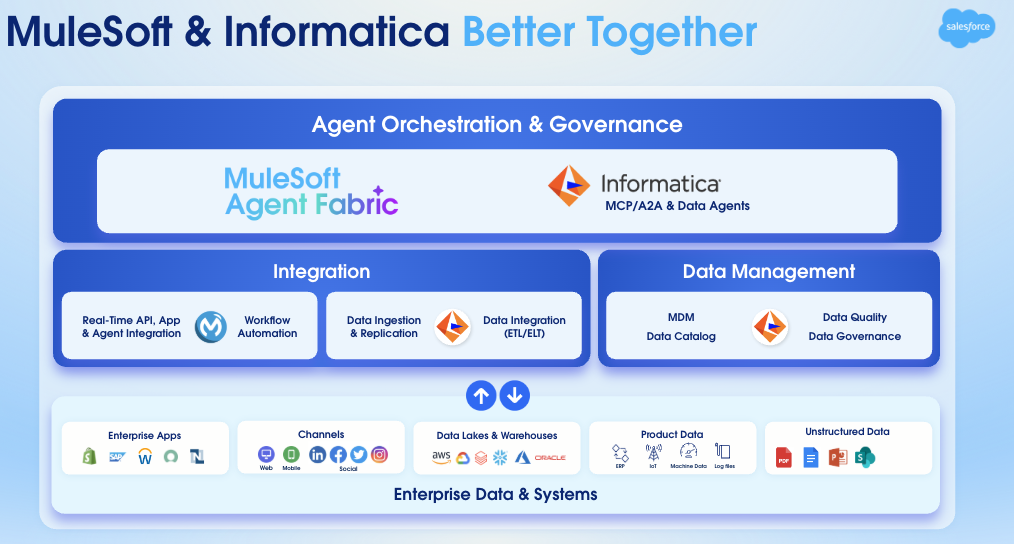
The following sections demonstrate how MuleSoft and Informatica work together across key foundational pillars–Integration, Data Management, and Agent Orchestration and Governance.
For every modern enterprise, successful operations rely on integrating applications and data planes. The application integration and data integration platforms are complementary, not interchangeable. Attempting to leverage one without the other creates operational blind spots and bottlenecks.
The shortcomings of siloed integration approaches are clear.
1. Application Integration Without Robust Data Governance
Connecting applications, or app integration, allows the enterprise to move processes and transactions quickly across systems. However, if this execution layer lacks a unified, governed, and trustworthy view of the underlying data, the resulting actions, no matter how fast, will be based on fragmented, inconsistent, or obsolete information.
Organizations can orchestrate processes quickly, but without trusted data, decisions remain high-risk. Inconsistent customer interactions, inventory management, and financial reporting stem from a lack of “single source of truth,” leading to inefficiencies and regulatory exposure.
MuleSoft mitigates this risk by providing out-of-the-box compliance for highly regulated industries, carrying active certifications including FedRAMP, ISMAP, HITRUST, SOC 1/2/3, and ISO 27001. However, even when the application layer communicates securely, it may still share incoherent data.
2. Data Integration and Management Without Agile Application Integration
Prioritizing data integration and management platforms—especially through a powerful data warehouse or master data management (MDM) system—is essential for cleaning, standardizing, and unifying data. These platforms create a single source of truth: a reliable, holistic view of entities like customers, products, or vendors.
While the data is clean, consolidated, and trustworthy, the mechanisms to inject its derived intelligence back into live business processes and customer-facing applications are sluggish or non-existent. Without app integration, the enterprise cannot translate a single source of truth into real-time action. High-quality data sits in the background, unable to influence an in-the-moment sales decision, a personalized service interaction, or a critical supply chain adjustment. The intelligence exists, but the operational pipeline remains blocked.
The Holistic Solution: MuleSoft and Informatica Together
MuleSoft and Informatica provide an industry-leading, unified framework for data-driven business operations.
This architectural alignment ensures:
-
Real-Time Action: MuleSoft provides the agile mechanism to expose this trusted data via secure APIs. Through API-led connectivity, it integrates Informatica’s single source of truth directly into critical business applications and processes. This allows the enterprise to act in real-time based on the foundation of the single source of truth provided by Informatica.
-
Trusted Context: Informatica, as the leader in cloud data management, ensures the data flowing through the enterprise is clean, consistent, governed, and compliant. It creates trusted context by mastering data, enabling quality assurance, and facilitating enterprise data governance.
The “Data-to-Agent” Moment
This integration enables customers to own the data-to-agent moment. This is the ultimate goal: when an employee (agent) or an automated system must act, the system instantly provides the complete, trustworthy, and real-time context necessary for success. This powerful synergy transforms data from a mere historical asset into a dynamic, actionable intelligence stream, driving superior business outcomes and competitive advantage.
MuleSoft provides an AI-powered, end-to-end integration lifecycle. With MuleSoft Vibes, Developers can use natural language prompts to design APIs, build integrations, and generate unit tests. The platform supports development in any IDE, including Cursor or VSCode, using local MCP servers to accelerate delivery.
The architecture centers on extensible connectivity: a universal bridge that connects AI agents, SaaS apps, legacy systems, and partners. This single platform makes sure that any asset can support the business in real time, regardless of where the asset lives.
Connectivity without oversight creates risk. That is why we allow teams to register, secure, and observe every asset and application. By providing a comprehensive AI toolset, we give IT the visibility and guardrails to manage the application lifecycle with total confidence.
MuleSoft also supports the broader ecosystem with enterprise B2B and EDI. This integration simplifies partner management while maintaining end-to-end compliance.
Ultimately, MuleSoft ensures that every part of the enterprise is not just connected, but governed and ready to act in real time.
Business velocity requires a foundation of trust. Informatica ensures that the enterprise acts on trusted, high-quality data, avoiding the liability of fast, yet unreliable, insights.
The Informatica platform can transform raw data into enterprise-ready assets. Its low-code environment facilitates instant scaling without increasing headcount. With over 300 pre-built connectors supporting all integration styles—including ETL, ELT, and Reverse ETL—it can integrate, govern, and prepare virtually any existing data for AI-driven initiatives.
Informatica is the data management powerhouse, essential for AI success. It provides a complete suite of capabilities, from cataloging to governance, that transforms organizations from data-rich to insight-driven.
AI is only as effective as the data that feeds it, and for most organizations, this data is siloed, duplicated, and inconsistent. This represents a significant risk, as “dirty” data leads to untrustworthy AI output.
This is where Informatica MDM excels. Instead of merely connecting data, we unify it. It breaks down disconnected silos to create a 360-degree view of customers, products, and suppliers, establishing a single, trusted source of truth. This unified view allows teams to confidently make AI-driven decisions without debating data accuracy.
Informatica is crucial for both initiating AI and scaling a trusted AI foundation across the entire enterprise.
Best of all, Informatica has automated the heavy lifting. With CLAIRE GPT, the platform streamlines the match, merge, and governance processes. This delivers a single source of truth to customers at lightning speed while eliminating manual effort.
Achieving a single source of truth is the first step. As data flows into analytics, applications, and AI, a critical concern emerges for CDOs and CIOs: “Can we truly trust this data everywhere it is consumed?”
In the AI era, data governance and quality are essential. They must be automated and intrinsically built-in, a capability Informatica is designed to deliver. Informatica embeds a layer of trust, ensuring that data is accurate and compliant before it reaches a dashboard or an AI model.
Informatica tracks not only the data, but its lineage, precisely showing its origin and access history to establish confidence in its reliability. This certainty is required to operate at scale.
Ultimately, Informatica connects metadata with business context. When a customer launches an AI project, they aren’t just moving quickly—they are moving with absolute certainty.
MuleSoft and Informatica offer complementary agent capabilities. MuleSoft Agent Fabric serves as the unified control plane, providing end-to-end governance, orchestration, and observability. Informatica’s data agents and MCP servers plug into this fabric, delivering trusted data access and governed data actions, such as feeding MDM data or catalog metadata to the ecosystem.
Together, they allow customers to scale their investments seamlessly. To operate this integrated ecosystem at enterprise scale, MuleSoft Agent Fabric provides a systematic, four-pillar framework:
- Discover: Gain complete visibility into your agent ecosystem. The Agent Registry and built-in scanners automatically synchronize and catalog every A2A agent and MCP server—including Informatica assets and external agents from Amazon Bedrock or Google Vertex—ensuring instant discovery and reuse.
- Orchestrate: Coordinate agents and APIs to execute complex workflows. The Agent Broker dynamically routes tasks to the correct agent or tool, eliminating manual handoffs and transforming scattered individual agents into a reliable, coordinated workforce.
- Govern: Apply secure, policy-driven control to every interaction. Trusted Agent Identity and Flex Gateway enforce compliance and access controls across three levels: end-to-end interactions, model-layer LLM requests, and execution-layer actions.
- Observe: Track agent reasoning, performance, and collaboration in real time. Agent Visualizer and centralized monitoring provide complete transparency, allowing IT teams to validate decisions, detect anomalies, and optimize agent outcomes.
The integration of MuleSoft’s control plane and Informatica’s data agents provides a unified framework for governed, real-time action. This synergy powers the agentic enterprise by anchoring agile orchestration in a foundation of trusted context.
To build a resilient agentic enterprise, organizations must move beyond treating data integration and application integration as isolated efforts. By leveraging Informatica to govern high-volume data assets and MuleSoft to orchestrate real-time application and agent workflows, enterprises establish a secure, scalable foundation.
Explore the dedicated resources for each platform to deepen your understanding. To learn more about real-time application connectivity, API-led integration, and the MuleSoft Agent Fabric for AI orchestration, explore the official MuleSoft product page. For comprehensive details on data management, governance, and Master Data Management MDM capabilities, visit the Informatica resource hub. You’ll find detailed specifications on each platform’s features, which will help you map the right architecture to your specific environment.